

Hello. We are CELITA Clinic in Seomyeon, Busan, with you from consultation to aftercare. When researching lifting procedures, you will often come across the names 'Ulthera' and 'Onda.' While both aim to lift sagging skin, the actual depth and method of action differ. Ulthera focuses ultrasound energy on deep layers, while Onda delivers microwaves to heat the dermis and underlying fat layers.
This article summarizes the differences in their principles, why they are often considered together, what the treatments feel like, the recovery process, and what you should check beforehand. Since effects and recovery responses vary by individual, we recommend making a final decision through a pretreatment consultation.
If One Lifting Procedure Felt Insufficient
There is a common scenario we hear in our clinic. Patients often say they tried a lifting procedure and felt their jawline was slightly defined, but their sagging cheeks or loss of elasticity remained unchanged. Facial changes do not occur in just one area. Skin surface elasticity, the underlying fat layer, and the deep support structures holding the face from the inside all age and change at different rates. Because of this, you might feel that a single procedure is not enough to address all your concerns. This is exactly why Ulthera and Onda are frequently mentioned together: they target entirely different depths.
Ulthera and Onda: How Do Their Mechanisms Differ?
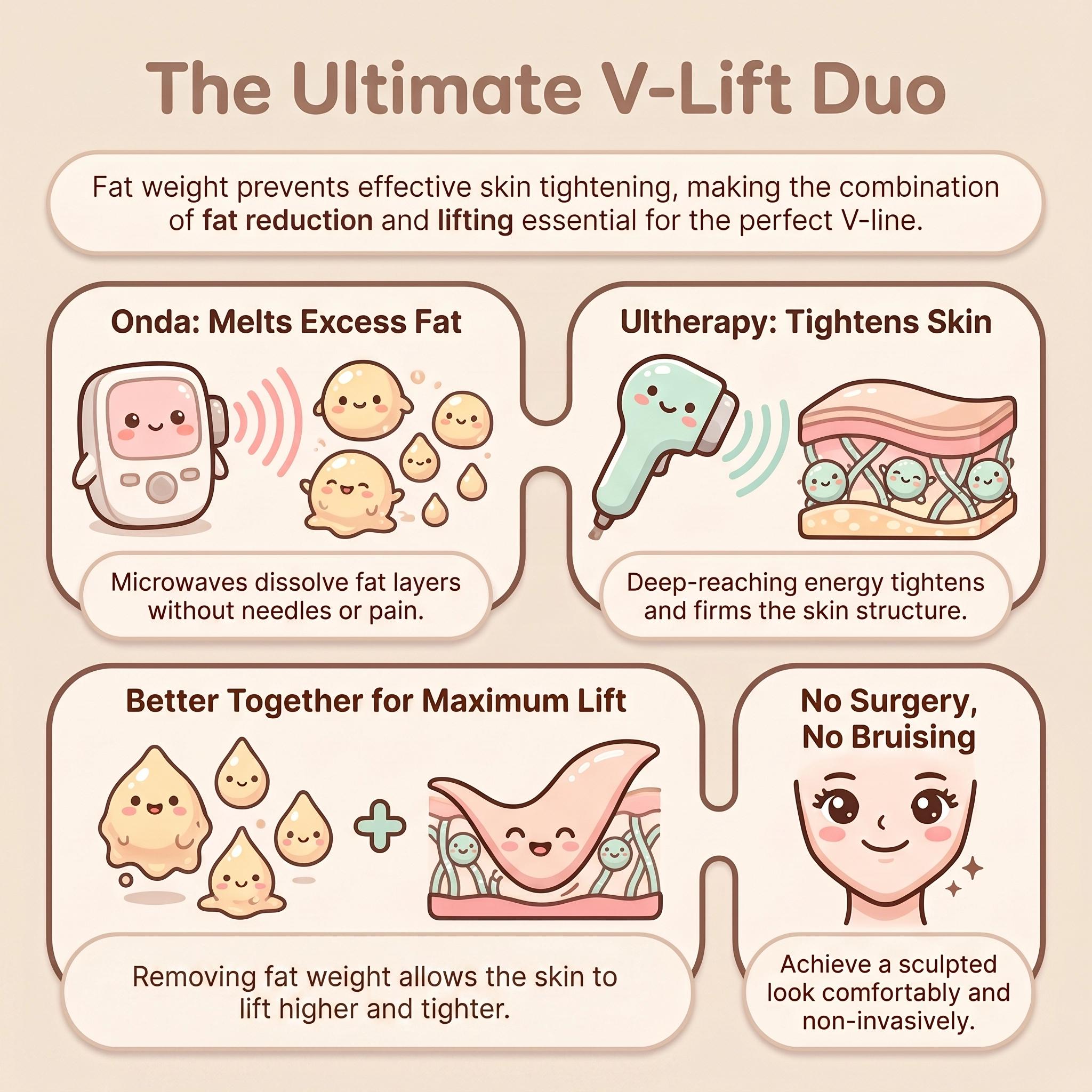
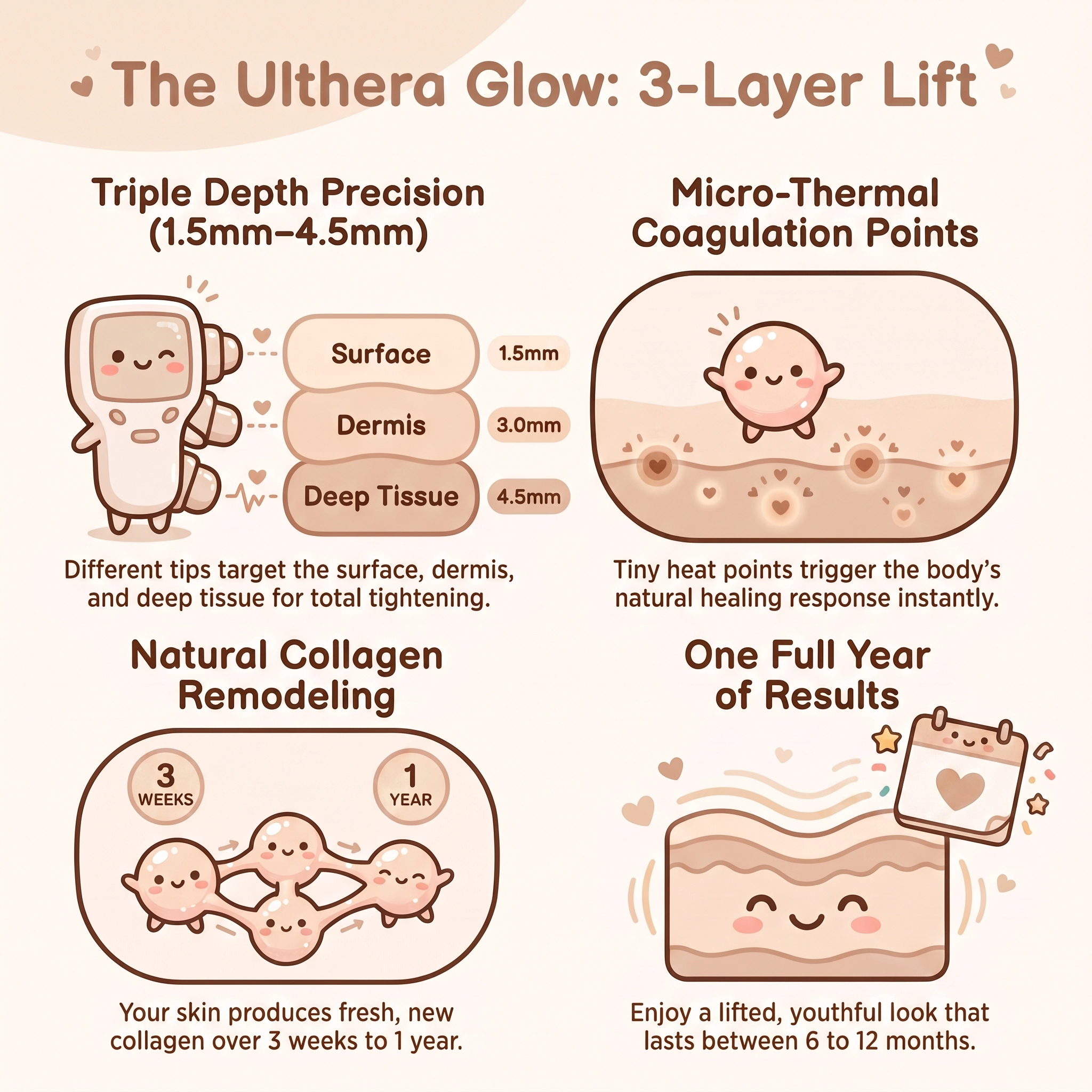
Ulthera delivers high-intensity focused ultrasound (HIFU) deep into the skin. Similar to using a magnifying glass to focus sunlight into a single point, it creates tiny thermal coagulation points in the targeted deep layers. It can reach the deep SMAS (Superficial Musculoaponeurotic System) layer that supports the inner face, using this stimulation as a signal to gradually regenerate collagen. Because it focuses on the deep layers, it is primarily used to refine sagging contours from the inside out. Changes typically appear gradually over several months, rather than immediately. During the procedure, the skin thickness can be monitored in real-time via the ultrasound screen.
Onda utilizes microwaves, functioning on a principle similar to a microwave oven. It rapidly vibrates water molecules within the skin to generate heat through friction. While a cooling system protects and cools the epidermis, heat is safely delivered to the dermis and the fat layer beneath it. Because it addresses dermal elasticity while also targeting sagging fat layers, some patients may feel their facial contours appear somewhat more refined as early as the day of the procedure. However, this immediate slimming effect is largely due to temporary heat-induced tissue contraction; true collagen remodeling continues over time.
In summary, the two procedures simply differ in their target layers and mechanisms; it is hard to definitively say one is better than the other. If deep sagging is your primary concern, Ulthera may be more suitable. If you are concerned about both surface elasticity and fat layers, Onda might be a better fit. Therefore, when concerns span multiple layers, the two treatments are sometimes considered together. However, no combination guarantees results, and the necessary procedures and scopes vary from person to person. It is best to decide what and how much to undergo after a thorough skin assessment.
At a Glance: Comparison
Feature | Ulthera | Onda |
|---|---|---|
Primary Energy | High-Intensity Focused Ultrasound (HIFU) | Microwaves (A type of high-frequency energy) |
Target Depth | Deep layers including the SMAS layer | Dermis and underlying fat layer |
Mechanism | Creates thermal points in deep layers to induce collagen regeneration | Vibrates water molecules to deliver heat to the dermis and fat layers |
Pain Level | Can cause stimulation/discomfort (intensity is adjustable) | Mostly a warm heating sensation (varies by individual) |
Downtime | Generally short | Generally short |
Effect Onset | Gradual over several months | Some may notice effects relatively early |
Best Suited For | Deep sagging, contour refinement | Concerns regarding both surface elasticity and fat layers |
Note: The above is a general description; perceived pain and recovery patterns vary by individual.

Not Recommended In The Following Cases
If any of the following apply to you, you must consult thoroughly with the medical staff before treatment, and in some cases, the procedure may not be possible:
Those who are pregnant or breastfeeding.
Those with open wounds, active infections, or severe inflammation in the treatment area.
Those with a history of keloid scarring or autoimmune diseases.
Those with electronic medical implants, such as pacemakers or metal implants (especially for Onda, which uses electromagnetic energy).
Those who have recently received fillers or other energy-based treatments in the same area (interval adjustments may be necessary).
How is the Procedure Performed, and How Long is the Recovery?
The procedure begins after cleansing and checking your skin condition. Onda provides a gentle, building warmth, so some patients receive it without anesthesia. Ultherapy can cause momentary discomfort when the energy hits deep layers, so the intensity is adjusted throughout the process. Since pain perception varies, we tailor the intensity during the session. Procedure time varies depending on the targeted areas and scope, which will be discussed during your consultation.
Immediately after the procedure, you may experience slight redness, mild warmth, swelling, or minor indentations, but these usually subside quickly. Both treatments have relatively short downtime, and many patients wash their faces, apply light makeup, and return to their daily routines right away. Rarely, blisters, pigment changes, or temporary numbness/tingling may occur. If these reactions persist, please contact the clinic. Recovery speed also varies by individual.
Recommended For Those Who:
Are concerned that their jawline and facial contours are less defined than before.
Feel a sense of sagging combined with a loss of skin elasticity.
Felt that a single lifting procedure was insufficient.
Want to address deep sagging and surface elasticity simultaneously.
Want a lifting procedure but wish to minimize the burden of recovery.
Need a treatment with a short recovery period due to a busy schedule.
Even if the above apply, we make the final decision on the procedure after jointly examining your skin condition beforehand.
To Maximize the Effects
Starting about two weeks before the procedure, it is best to avoid strong exfoliation or highly stimulating lasers and keep your skin well-moisturized. Avoiding excessive alcohol and strenuous exercise the day before and arriving in good condition will aid your recovery. For about a week immediately following the procedure, wash your face only with lukewarm water and avoid rapid skin-cooling methods like ice packs or cooling masks. Both treatments utilize heat to stimulate a collagen response; cooling the skin too rapidly right after can diminish this reaction. Instead, apply more moisturizer than usual and ensure you wear sunscreen with SPF 50 or higher when going outside.
The following 1 to 3 months is the period when collagen rebuilds within the skin, so consistent moisturizing and UV protection are highly beneficial. The number of sessions and the intervals between them depend on your skin condition, so it is best to decide whether to proceed with a series of treatments through consultation. If you decide to receive both treatments, whether to do them on the same day and in what order will be determined based on your skin. If you are planning other treatments like fillers, please discuss the order and timing with the medical staff in advance.
Why Busan Seomyeon, and Why CELITA Clinic?
CELITA Clinic is located on the 4th floor of the Bujeon Medical Building, close to Exit 15 of Seomyeon Station. Before deciding on a procedure, there are four things we recommend patients check for themselves:
Whether genuine equipment and authentic consumables are used.
Whether the appropriate dosage for the treatment area is shared transparently in advance.
Whether the price, including VAT, is provided upfront.
Whether an objective skin analysis is conducted prior to the procedure.
CELITA Clinic conducts a pre-treatment skin analysis using the Eve V MUSE AI system. Our medical staff reviews the results together with the patient before outlining the treatment plan. For our international visitors, we offer support in Japanese, Traditional Chinese, and English, in addition to Korean.
Quick Summary
Ulthera uses ultrasound to reach the deep SMAS layer, while Onda uses microwaves to target the dermis and fat layers, operating at completely different depths.
Ulthera is better suited for deep sagging, while Onda is ideal for surface elasticity and fat layers. If concerns span multiple layers, they are sometimes considered together.
Both procedures have relatively short downtime, but reactions like redness and swelling, as well as recovery speed, vary by individual.
Before treatment, we recommend personally verifying the use of authentic equipment, upfront pricing, and pre-procedure skin analysis.
Frequently Asked Questions (FAQ)
Q. Are Ulthera and Onda the same procedure?
A. They are distinct procedures using different equipment and principles. Ulthera acts on deep layers with ultrasound, while Onda targets the dermis and fat layers with microwaves. Because their depths and mechanisms of action differ, they are suited for different types of concerns.
Q. Do I have to get both treatments together?
A. No, you do not. Depending on your skin condition and concerns, you may only receive one. Whether to proceed with both is determined after assessing your skin during the pre-treatment consultation.
Q. Can I return to my daily life immediately after the procedure?
A. The downtime is relatively short. However, redness or swelling may briefly linger, and the time it takes to subside varies by person. Generally, washing your face and applying light makeup right after are fine.
Q. When will I start to see the effects?
A. With Onda, some patients notice a refined contour as early as the day of the procedure. Ulthera requires time for collagen to rebuild, so its effects typically emerge gradually over several months. The timing and degree of results vary by individual.
Reservations & Inquiries
You can book a free consultation or browse our current events and packages via WhatsApp. From planning your visit to providing pre- and post-treatment guidance, the Celita Clinic team is here to assist you.
Disclaimer This content is provided for informational purposes only and cannot replace professional medical advice. Individual results may vary. Please consult thoroughly with qualified medical professionals before undergoing any procedure.